Vibration Feet for Turbo Trainers
A turbo trainer in a rented flat sends vibration through the floor as structure-borne noise, into the ceiling below. What vibration feet for a turbo trainer do about it — and what they explicitly don’t — compared with tennis-ball DIY and self-printed feet.
The problem: a turbo trainer in a rented flat
A smart trainer usually sits on a hard floor — laminate, tile, sometimes directly above the flat below. When pedalling, especially out of the saddle or at higher power, some of that force transmits not just as sound but as structure-borne vibration through the floor into the neighbour’s ceiling. That’s a different thing from loudness in your own room — it’s exactly the part neighbours complain about, even though you barely hear anything yourself. Anyone training in a block of flats or a rented flat with thin ceilings usually already knows this problem from experience, before the first note under the door.
What vibration feet do — and don’t
Vibration feet target exactly this structure-borne noise: they decouple the trainer minimally from the floor, taking out some of the vibration before it reaches the building fabric. That noticeably reduces the dull thud that arrives downstairs or next door. What they don’t do: make the trainer itself quieter. The running noise of the drivetrain — chain, sprockets, freehub — comes from the mechanics of the bike and the trainer, not from contact with the floor, and vibration feet don’t reduce it. If your setup is loud to begin with (an old cassette, a dry chain), you’ll notice little from vibration feet — they work against structure-borne noise, not airborne noise.
A rocker plate effect, in miniature
A full rocker plate is a large base plate that lets the whole trainer sway slightly from side to side — that eases the hips and lower back on long sessions, and counters the rigid, unnatural feel of a fixed base. Vibration feet aren’t a substitute for a full rocker plate, but they give the trainer a similar effect on a smaller scale: a small, noticeable side-to-side motion out of the saddle, instead of the total rigidity of a trainer sitting straight on the floor. For most hobby riders, mainly trying to solve the neighbour problem rather than riding hours at a stretch out of the saddle, that small effect is plenty as a pleasant side benefit.
Ready-bought vs self-printed vs tennis-ball DIY
Online, you’ll mainly find free STL files for 3D printing and the classic tennis-ball fix. A fair comparison:
| Option | Effort | Cost | Result |
|---|---|---|---|
| Tennis balls under the feet | low, ready right away | around €5–10 for a set | noticeably dampens vibration, but the trainer sits less stable and can shift |
| Self-printed STL feet | high — your own 3D printer, material, time to fine-tune | material cost low, but a printer is required | works if the printer and material cooperate — result depends heavily on your own setup |
| Ready-printed vibration feet | none — ready to use straight away | €79.90 | sized precisely for your trainer, with no printer or tinkering required |
Honestly, the tennis-ball option isn’t a bad stopgap for a quick test of whether damping helps at all — it’s just less stable and less durable than a proper fitted solution. If you don’t own a 3D printer, or would rather skip the fine-tuning, a ready-made set is the simpler route.
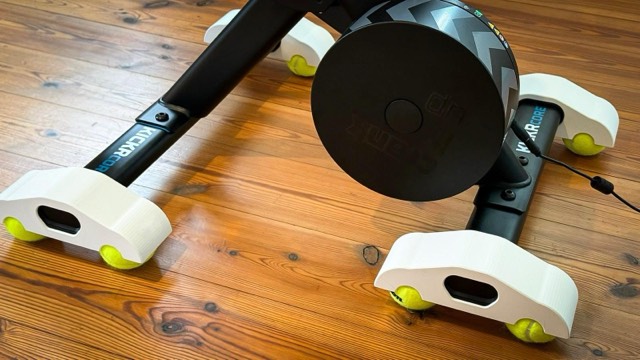
Fitting in two minutes
The vibration feet fit under the trainer’s existing feet — no tools required. The trainer just needs a brief lift, after which it sits on the vibration feet just as stably as before, with the added decoupling from the floor. In practice, the whole thing takes a few minutes.
The rest of the indoor setup
Riding indoors takes more than damping — there’s also the question of where the screen or tablet goes; a dedicated table or a stand right in front of the bike keeps that tidy, more on the page about the indoor cycling tablet holder. As a gift, the Rocker Plate Feet from €19.90 are incidentally the cheapest tier in the Gifts for Cyclists overview.
Compatibility
The vibration feet are built and fitted for common smart trainers. Foot mounts and dimensions differ noticeably between manufacturers and models — a blanket promise that they’d fit any given trainer wouldn’t be honest without checking the individual case. If you’re unsure about your own model, just ask beforehand instead of ordering on a hunch.
Frequently asked questions
How do you make a turbo trainer quieter?
Some of the perceived noise is structure-borne, through the floor — vibration feet or a floor mat help with that. The actual running noise from the chain and drivetrain isn’t affected; a well-maintained, well-oiled chain and a cleanly adjusted drivetrain help most there.
Do you need a rocker plate for a turbo trainer?
Not strictly — plenty of people ride without one. It’s mostly appreciated on long, intense sessions, since it eases the hips and lower back. For everyday use, vibration feet are already enough of a step up for most people.
Do tennis balls work under a turbo trainer?
Yes, as a quick fix they noticeably dampen vibration. The downside: the trainer sits less stable on them and can shift under a hard effort — for a permanent setup, a fixed, properly fitted solution is more practical.
Are vibration feet the same for every turbo trainer model?
No, not necessarily — the foot mounts differ between manufacturers and models. It’s worth checking beforehand whether the fit matches your own trainer.
Will a smart trainer disturb the neighbours below me?
It can, if vibration travels through the floor into the ceiling of the flat below — regardless of how loud the trainer sounds in your own room. Vibration feet reduce exactly that transmission path, though there’s no full guarantee against every complaint, since the building fabric itself also plays a part.
Next: Wooden Bike Wall Mount · Indoor Cycling Tablet Holder
updated: august 2026
Your trainer model isn’t listed?
Before ordering on a hunch: send a short message about which trainer model you ride, and we can work out whether the standard shape fits or an adjustment is needed.